We’re a registered Medicare provider, but not with Medicaid or Dentaquest.

Restore Your Smile: Crowns & Bridges!
Missing a tooth or teeth not only can impact your smile, but it can also impact your overall dental health. Missing teeth can cause a shift in the alignment of your remaining teeth, an improper bite, and improper hygiene due to tipping of teeth.
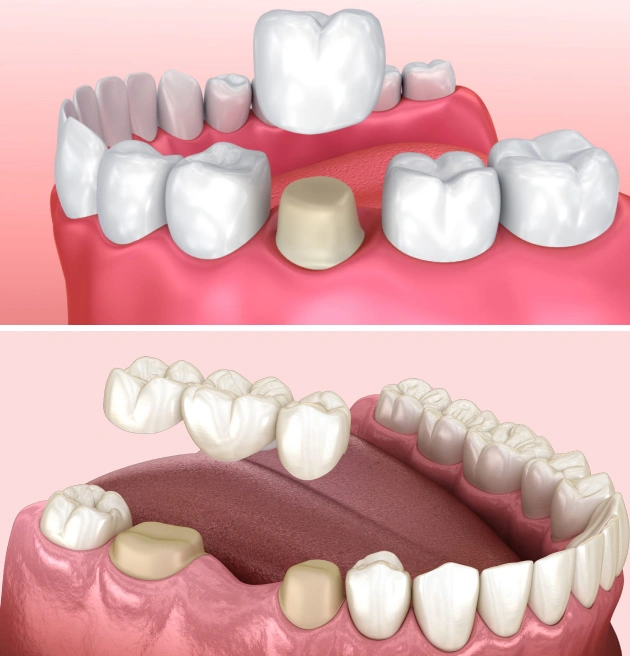
Getting a dental crown can help alleviate these issues. A crown is a cap that encases an entire tooth. This process is done when that tooth cannot be restored with a standard dental filling.
Dental crowns are used in instances such as:
- Cracked teeth
- Protecting a tooth after a root-canal
- Worn down, or weakened tooth
- Cover a poorly shaped or discolored teeth
Another option for repair is a dental bridge to replace one or several missing teeth by using your existing natural teeth for support.
If you would like to find out if you’re a candidate for a crown or a dental bridge, contact our team to schedule a consultation.
How Crowns and Bridges Enhance Your Smile
Dental crowns and bridges are restorative treatments designed to restore a tooth's full function and enhance the appearance of your smile. Each serves a unique purpose—read on to learn more about their individual benefits!
Dental Crowns: Protecting and Strengthening Your Teeth
Dental crowns, often referred to as tooth caps, are designed to cover and protect a tooth, serving as a sturdy shield against further damage. Our dentists in Fort Lauderdale, FL may recommend a crown in the following situations:
- When a cavity is too large for a filling to manage effectively
- For a tooth that is decayed and already has multiple fillings
- To support a broken or cracked tooth
- To reinforce and protect a tooth that has undergone a root canal
- To restore a poorly shaped or sized tooth
At Gold Coast Dental Center, we use only high-quality ceramic and zirconia crowns that are both durable and blend seamlessly with your natural smile.
Dental Bridges: Replacing Missing Teeth
A dental bridge is a prosthetic device that replaces one or two consecutive missing teeth. It consists of an artificial tooth with crowns attached on either side. The artificial tooth fills the gap in your smile, while the crowns anchor to the adjacent healthy teeth for support.
To place a dental bridge, the adjacent teeth must be strong and healthy enough to support the crowns. If they aren’t, don’t worry—our dentists will discuss alternative tooth replacement options, such as dental implants.
Why Fixing Broken and Missing Teeth Is Important
Chewing with missing or damaged teeth can be painful due to the way our teeth function. Each tooth has a specific role, and when one is missing, the surrounding teeth must work harder to compensate, leading to excessive wear and strain on the jaw joint. This added pressure can result in teeth grinding and TMJ (temporomandibular joint) issues.
Promptly addressing broken or decayed teeth is crucial for maintaining oral health. If a damaged tooth is left untreated, it will likely worsen, requiring more complex treatments in the future.
Additionally, failing to replace a missing tooth can lead to jawbone deterioration, increasing the risk of further tooth loss and giving your smile an aged appearance.
To protect your long-term oral health, it’s essential to address issues with broken and missing teeth as soon as possible.